The best CRM for Instagram DM setter teams: a buyer's checklist
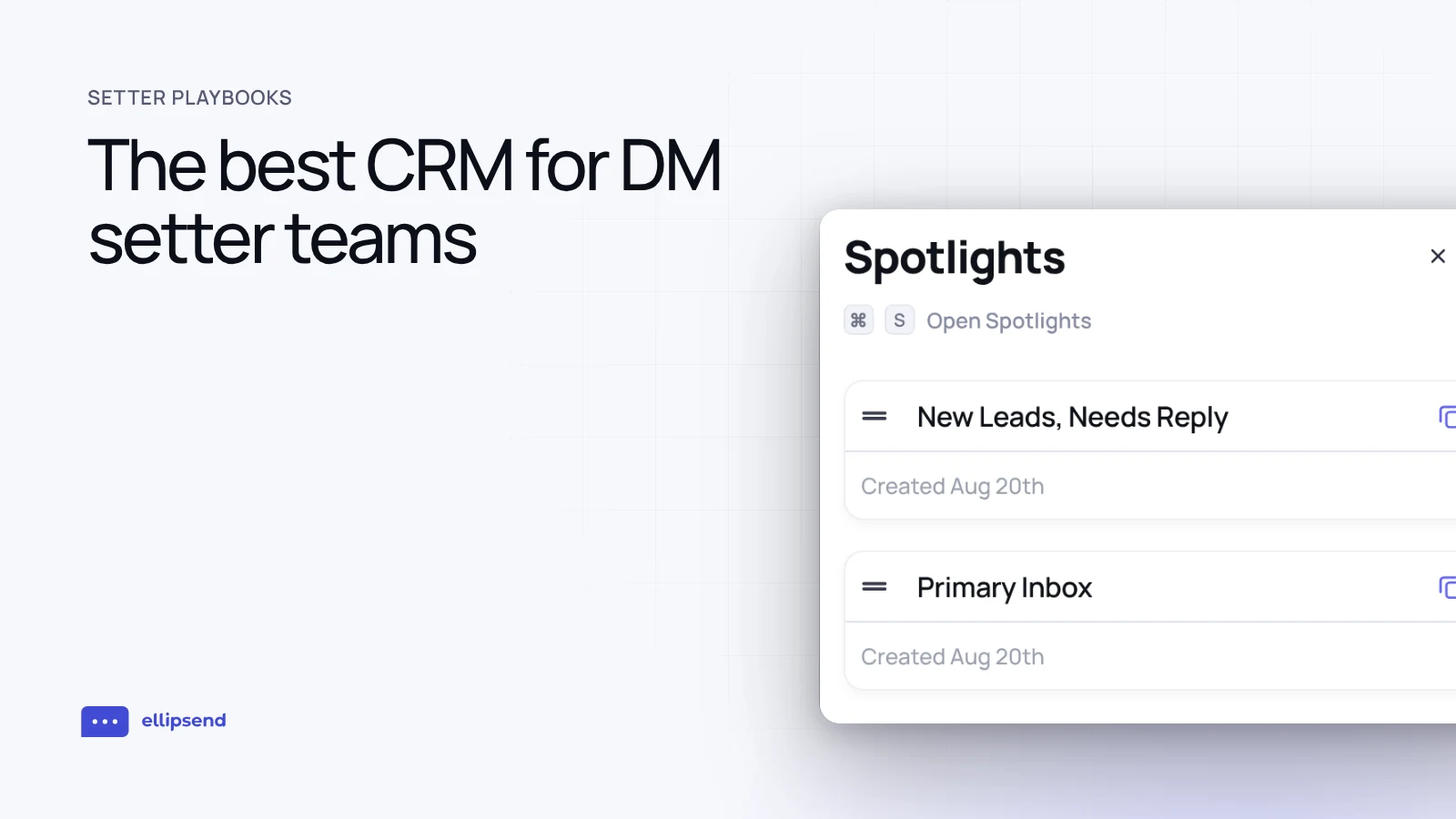
The best CRM for an Instagram DM setter team is one built around the DM inbox. Setters should move leads through a pipeline from inside the conversation, managers should see each setter's performance, and every sale should trace back to the post that started the conversation. A DM setter is the person who works your Instagram and Facebook DMs to qualify leads and book calls. A DM CRM is software that holds those conversations, the pipeline and the revenue in one place.
Many setter teams run on two screens. Instagram on one, a CRM or a spreadsheet on the other. The setter has the conversation in one tab and records it in another.
That second tab is where the data goes wrong. Leads get logged late or never.
What is a DM CRM?
A DM CRM is a CRM where the DM conversation is the main record. The messages, pipeline stage, owner and purchases all sit on the same contact.
A general CRM starts from the deal, and conversations get attached to it. For a team that sells in Instagram and Facebook DMs, that's upside down. The conversation is where the selling happens, so the CRM should live there.
There are three kinds of tools in this space. DM automation tools start conversations from comments and keywords. General CRMs and all-in-one platforms add Instagram as one channel among many. DM CRMs are built for teams of humans selling in the DMs. All three show up when you search for "Instagram CRM," so a checklist helps more than a ranking.
Why do general CRMs struggle with DM setter teams?
Two reasons.
The copy-paste problem. When the CRM isn't where the conversation happens, every update is manual. The setter qualifies a lead in the DMs, then switches tabs to move the deal, add a note and log the booking. Say each of four setters handles a hundred conversations a day. That's hundreds of small manual updates, and each one is a chance to skip it when the inbox is busy.
No post attribution. Most CRMs track sources at the level of a form, a landing page or an ad. A DM lead often starts with a comment on a reel or a reply to a story. Unless something records which post started the conversation and carries it through to the sale, the revenue lands in the CRM with no content attached. You end up making more of what got views instead of what got paid.
Both problems get worse as the team grows. One setter can keep a spreadsheet honest. Five can't.
What should a CRM for DM setters do?
Use this as the checklist. No tool needs to win every row, but the gaps should be ones you can live with.
| Criterion | Why it matters for a setter team |
|---|---|
| Instagram and Facebook DMs through Meta's official API | The tool connects through Meta's approved channels, so your team doesn't need your Instagram password |
| Comment, story and keyword automations | Automations start the conversation and deliver the first message instantly, so setters pick up warm leads |
| Pipeline inside the inbox | Setters move leads to the next stage from the conversation, with no second tab |
| Assignment | New leads get split between setters by rule, so nobody cherry-picks and nothing sits unowned |
| Setter metrics | You can see each setter's response rate and dollars per DM conversation (dollars per DM), not just messages sent |
| Post-level revenue attribution | Every sale traces back to the post, story or ad that started the conversation |
| Booking and payment integrations | Booked calls and payments land on the lead automatically instead of being typed in |
| Mobile app | Setters can answer leads away from a desk |
Two rows deserve more space.
Setter metrics. Messages sent is the number most teams track and the least useful. Dollars per DM is the revenue (total sale value, including payment plans) from a setter's leads divided by the number of leads that setter messaged. Say one setter averages $49 per conversation and another averages $16. The first earns about three times as much per conversation, even if the second sends more messages. A CRM that can't show that number per setter leaves you guessing who to coach.
Post-level revenue attribution. Ask the vendor for the exact mechanism. Something has to record which post brought the lead in, the links setters send need to identify that lead, and the sale has to get recorded on that same lead. If any of those three needs a person to remember it, the attribution won't survive a busy week.
How do the main options compare?
Here's how seven tools line up against the checklist, including Winly (formerly Revio), based on each vendor's own site and help docs as of October 2026. ManyChat is a DM automation tool, not a CRM. It's included as a baseline.
| GoHighLevel | Kommo | respond.io | Mochi | Winly | ManyChat | Ellipsend | |
|---|---|---|---|---|---|---|---|
| Price per month, billed annually (as of October 2026) | $970 / $2,970 / $4,970 per year | $25 / $35 / $45 per user, 6-month term (shortest offered) | $79 / $159 / $279 | $149 / $297 / $497 billed monthly, 25% off billed yearly | Not published. Quotes we've seen are around $597 a month | Free, then $14 / $29 / $69 / $139 | Core $29, Pro $249, Pro+ $399, Premium $749 |
| What you pay for contacts | Unlimited contacts | Lead limits per user (2,500 / 5,000 / 10,000) | Price scales with contacts | Priced by active conversations (300 / 1,000 / 5,000) | Not published | Priced by active contacts (25 to 25,000), extra contacts $0.004 to $0.10 each | Unlimited contacts on every plan, no per-contact fees |
| Instagram DMs | Yes | Yes | Yes | Yes | Yes | Yes | Yes |
| Facebook DMs | Yes | Not stated | Yes | No (Instagram only) | Yes | Yes | Yes |
| Official Meta API named on its pages | Not stated | Not stated | Not stated | Yes | Says it works within official APIs, API not named | Yes | Yes |
| Comment and keyword automations | Yes, Instagram comment trigger with phrase filters | Yes | Not stated | Yes | Yes | Yes | Yes |
| Pipeline | Yes, opportunities | Yes | Lead management, no explicit pipeline stated | Yes, stage views in the inbox | Yes, stages, tags and ownership | No pipeline in its docs | Yes, stages set from the inbox |
| Assignment | Yes | Not stated | Yes, routing and lead distribution | Yes, percentage lead routing | Yes, ownership and handoffs tracked, own queue per rep | Yes, shared inbox assignment from $99 plan | Yes, auto-assignment by percentage |
| Setter metrics | Per-user SLA and response time dashboard; Instagram coverage not stated | Not stated | Agent analytics claimed, metrics not listed | Response times, reply rates, revenue and commission per setter | Speed to lead, response rates and rep performance | Not stated in official docs | Response rate and dollars per DM per setter |
| Revenue attribution | Contact source and ad UTMs; organic post revenue not stated | Not stated | ROI by ad, agent and channel claimed | Tracked links and pixel tied to content source | Not advertised on its site | Post-level automation stats, no revenue | Revenue per post, story and ad |
| Booking and payments | Built-in calendars and payments | 100+ marketplace integrations | CRM integrations | Payments from Stripe, Whop, FanBasis, Ablefy; no scheduling stated | Not stated | Zapier, Make, HubSpot, Google Sheets | Calendly, GoHighLevel, Zapier and API |
| Mobile | Yes | Not stated | Not stated | iOS push notifications | Not stated | Yes | iOS and Android apps |
"Not stated" means the vendor's pages we checked didn't say it. It doesn't mean the product can't do it. In the Meta API row, it means the pages we checked don't name the API, not that a tool connects some other way. Check anything that matters to you on a demo or a trial.
Watch the contacts row as closely as the price row. Ellipsend never charges per contact, so a viral reel that floods your DMs doesn't raise your bill.
Meta also offers a free inbox in Meta Business Suite for Instagram and Facebook messages, with labels, notes and a Leads tab. The help pages we checked don't describe a pipeline or deal stages.
Which DM CRM fits which team?
GoHighLevel fits teams that want one platform for everything. Calendars, payments, email, SMS and pipelines are built in, and Instagram DMs land in the same inbox as every other channel. The trade-off is that Instagram is one channel among many. Its attribution docs center on forms, calendars and ad UTMs, and they describe no built-in report tying revenue to an organic Instagram post. Some teams use it as the back office next to a separate DM tool.
Kommo fits small businesses and agencies that want a classic sales pipeline with Instagram and other messaging channels in one inbox, priced per user. Keyword comment-to-DM flows are on its Instagram page. Note the shortest term it offers is six months. The page doesn't cover setter reporting or post attribution.
respond.io fits businesses whose customers message across many channels, like WhatsApp, TikTok, Instagram and Facebook, and that need routing across a support or sales team. Its pages focus on omnichannel conversations and routing, and the ones we checked don't mention comment-to-DM.
Mochi is one of the closest to a purpose-built DM CRM for setter teams on this list. It has lead routing by percentage, per-setter revenue and commission, payment syncing and tracked links. It's Instagram only, and it leans into AI, with a reply agent that can qualify and follow up on its own. That suits teams that want AI working leads. It's a different model from setters doing the selling.
Winly (formerly Revio) fits high-ticket coaches and the setters, closers and managers who sell for them, especially teams that want coaching bundled with the software. Each rep gets their own login and queue, workflows start from comment keywords, story replies and messages, and an AI Copilot drafts replies for reps while an AI Sales Coach scores conversations. It reports speed to lead and response rates. Its site doesn't advertise revenue tied to posts, and it doesn't publish pricing, so you book a call for a quote.
ManyChat is a widely used tool for starting conversations, with comment, story and keyword automations and a team inbox with assignment from its $99 plan. Its docs describe no sales pipeline, and its analytics report automation activity per post, not revenue. It works well as the automation layer, but on its own it isn't a CRM for a setter team.
Ellipsend is built for human setter teams selling in Instagram and Facebook DMs.
How to choose
Start with how your team sells. If a setter books a sales call, the checklist above is the whole job. If an automation sells a low-ticket product with no human involved, a DM automation tool and tagged links may be all you need.
Then test two things. Ask a setter to work a lead from first message to booked call without leaving the inbox. Then ask the tool to show the revenue from one specific post last month. If either one takes a spreadsheet, you've found the gap.
How Ellipsend handles it
Ellipsend is a DM sales platform for setter teams. Keyword automations start the conversation from comments, story replies, DMs and ads. Setters work every lead from one inbox for Instagram and Facebook, with the pipeline right there in the conversation, and new leads can be split between setters automatically.
Sales can be traced back to the post, story or ad that started them, and each setter's dollars per DM sits next to their response rate. Speed to lead and follow-ups come from the same conversations. So you know which content to make more of and which setter to learn from.
Learn more about EllipsendFrequently asked questions
What is the best CRM for Instagram DM setters?
The best CRM for Instagram DM setters is one built around the DM inbox. Setters can move leads through a pipeline from inside the conversation, managers can see each setter's performance, and revenue is tied back to the post that started the conversation. A DM setter is the person who works Instagram and Facebook DMs to qualify leads and book calls.
Is ManyChat a CRM?
ManyChat is a DM automation tool, not a full CRM. It starts conversations from comments, story replies and keywords, stores contacts with tags and fields, and has a team inbox. Its docs describe no sales pipeline, and its analytics cover automation activity per post, not revenue.
Can GoHighLevel be used as a CRM for Instagram DMs?
Yes, GoHighLevel can be used as a CRM for Instagram DMs. It brings Instagram DMs into one inbox with email, SMS and other channels, and has pipelines, calendars and payments built in. Its attribution docs focus on forms, calendars and ad UTMs. As of October 2026, its help docs describe no built-in report that ties revenue to a specific organic Instagram post.
What is a DM CRM?
A DM CRM is a CRM where the Instagram or Facebook DM conversation is the main record. The lead's messages, stage, assigned setter and purchases sit on one contact, so setters update the pipeline from the conversation.
How much does a CRM for Instagram DM setters cost?
Among the tools compared above, CRM plans run from $25 per user per month to $497 per month, as of October 2026. Kommo starts at $25 per user per month on its six-month term. GoHighLevel runs $97 to $497 per month, or $970 to $4,970 per year billed annually. Mochi runs $149 to $497 per month. Winly doesn't list prices publicly. Quotes we've seen are around $597 a month. Meta's built-in inbox is free. Usage charges, extra seats and add-ons can change the real price.
What metrics should a DM CRM show for each setter?
A DM CRM should show each setter's response rate and dollars per DM conversation (dollars per DM) at minimum. Dollars per DM is the revenue (total sale value, including payment plans) from a setter's leads divided by the number of leads that setter messaged. It adjusts for volume, so setters compare fairly. Messages sent alone says nothing about whether conversations made money.
 Know which posts make you money
Ellipsend gives setter teams one DM inbox, a sales pipeline and revenue traced to every post.
Try Ellipsend