DM setter KPIs: the 7 numbers every setter team should track
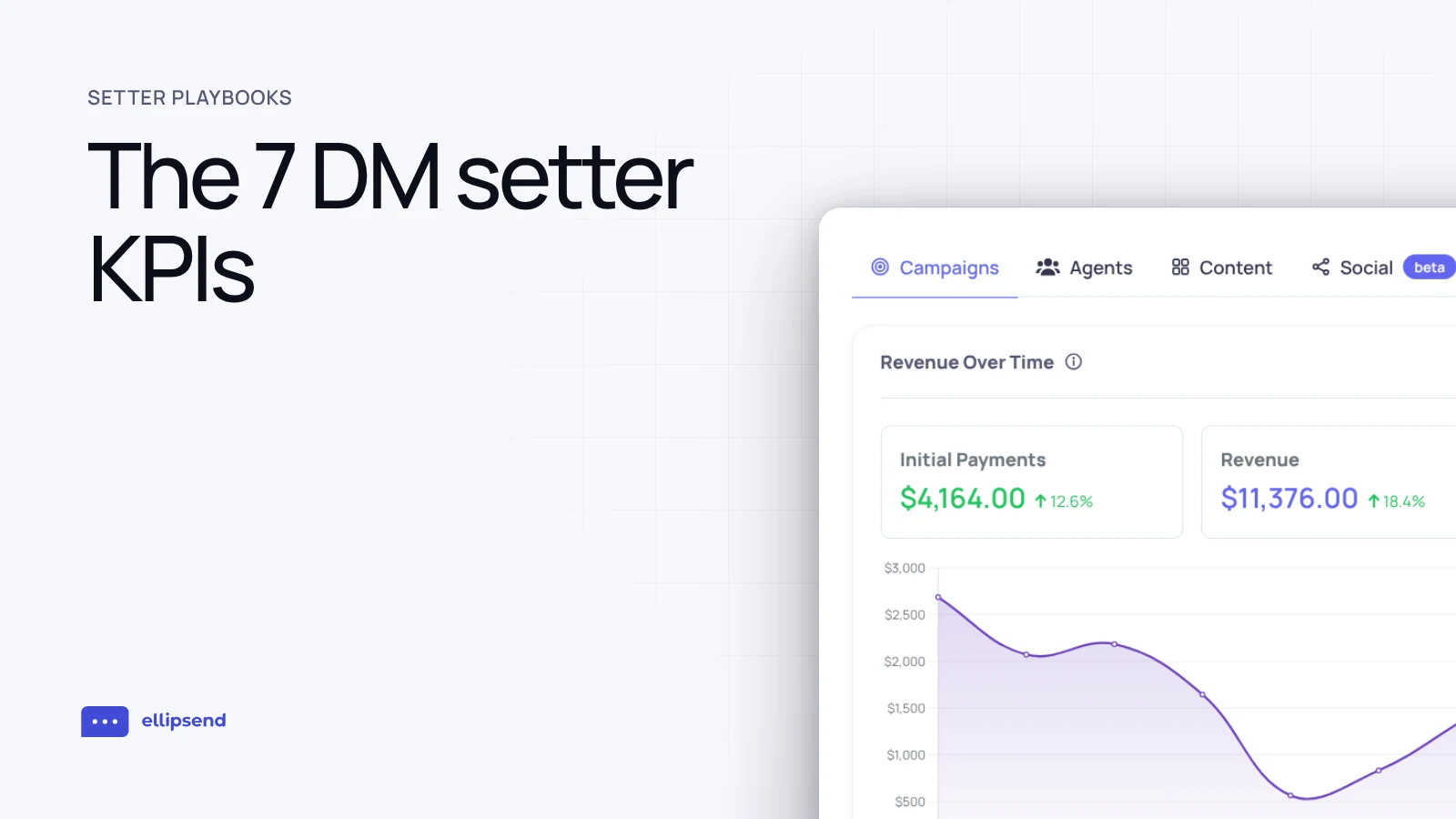
The seven KPIs every DM setter team should track are speed to lead, response rate, qualified rate, follow-up coverage, follow-up reply rate, booking rate and dollars per DM conversation (dollars per DM). A DM setter is the person who works your Instagram and Facebook DMs to qualify leads and book calls. Dollars per DM matters most. It's the revenue from a setter's leads divided by the number of people they talked to, so it adjusts for volume and shows whether each setter is improving over time. The other six tell you why it moved.
Plenty of setter teams still judge setters on messages sent. A setter who sends 600 messages a day looks like your hardest worker. That number says nothing about whether those conversations made money.
And when revenue drops, the setter usually takes the blame. Even when the real cause was a week of posts that pulled in people who were never going to buy.
What KPIs should you track for DM setters?
Every KPI below uses the same unit, a conversation, meaning one lead the setter messaged in the period you're looking at. Keep that consistent and the numbers compare cleanly.
| KPI | What it tells you | How to calculate it | Benchmark |
|---|---|---|---|
| Speed to lead | How fast a setter jumps in once a lead is ready to talk | Time from the lead replying to your automation to the setter's first message | Data coming |
| Response rate | Whether leads are being left on read | Conversations where the setter sent the last message ÷ conversations | 90 to 95% (our recommended target) |
| Qualified rate | How many leads fit your offer | Qualified leads ÷ conversations | Data coming |
| Follow-up coverage | Whether leads who go quiet get chased | Quiet leads that got at least one follow-up ÷ leads who went quiet | Data coming |
| Follow-up reply rate | Whether those follow-ups bring people back | Follow-ups that got a reply ÷ follow-ups sent | Data coming |
| Booking rate | How many conversations turn into calls | Booked calls ÷ conversations | Data coming |
| Dollars per DM | What each conversation is worth | Total sale value from a setter's leads ÷ conversations | Your team's golden standard |
Speed to lead, response rate and the two follow-up numbers are fully in the setter's hands.
Qualified rate is shared. The setter decides who counts as qualified, but the bigger driver is who your content and ads bring into the DMs. Booking rate and dollars per DM are the result of everything together, the setter, the lead flow and, for dollars, the sales call too.
Why is dollars per DM the most important setter KPI?
Because it measures money while adjusting for volume.
Total revenue rewards whoever got handed the most leads. Calls booked counts calls with people who could never buy the same as calls with people who could.
Dollars per DM tells you what a conversation with this setter is worth. Say one setter averages $49 per conversation and another averages $16. The first one is bringing in about three times as much per conversation, even if the second one sends more messages or handles more leads.
It works across time too. Track each setter's number week over week against their own past and you'll see whether they're improving or slipping.
Two caveats. Judge it on a real sample, since 20 conversations is too few to mean much. And count the full sale value, including payment plans, so a setter isn't penalized because a buyer chose to pay in installments.
What's a good dollars per DM number?
There's no universal good number. A $500 offer and a $10,000 offer produce completely different results. What matters is your golden standard.
Your golden standard is your team's normal dollars per DM over a typical stretch, like the last 90 days. Say it's $30. That's the line every setter and every week gets measured against.
When the number lands near $30, there's nothing to do. When it jumps to $49 or falls to $18, something changed. Your job is to find out what before you react.
What does it mean when dollars per DM goes up or down?
This is where the other six KPIs earn their place. Line them up next to dollars per DM and the cause usually shows.
| What you see | Likely cause | What to check |
|---|---|---|
| Dollars down, qualified rate and booking rate down, setter's speed and follow-ups steady | Lead flow got worse | Which posts, stories or ads those leads came from |
| Dollars down, qualified rate steady, booking rate down, speed to lead or follow-ups slipped | The setter | Their conversations from that week |
| Dollars down, qualified rate, booking rate and every setter number steady | Something after the booking, like show-ups or the close | What happened on the calls |
| Dollars up, qualified rate and booking rate up | Better lead flow | Which post brought those leads in, then make more like it |
| Dollars up, qualified rate steady, setter numbers and booking rate up | The setter got better | What they're doing differently, then teach it to the team |
One more check before you blame anyone. Revenue often lands weeks after the conversation, once the call happens and the deal closes. A quiet week can just mean last month's calls haven't closed yet.
And remember that qualified rate partly reflects how strict the setter is. If one setter's qualified rate drops while everyone else's holds, look at how they're qualifying before you look at the content.
This is why you track all seven together. Dollars per DM tells you something changed. The rest tell you whether to coach the setter, change the content or look at the calls.
Without them, a setter gets blamed for a bad week of posts. Or credited for a great one.
How fast should a DM setter reply to a new lead?
Speed to lead is the time between a lead replying to your automation and a setter sending their first message. The clock starts when the conversation is ready for a human, not when the automation fires.
Across the accounts in our benchmarks, the median was Data coming, and Data coming of leads got a human reply within 30 minutes.
Speed to lead mostly comes down to coverage. Somebody has to be in the inbox when the leads show up, which is why it's worth knowing Data coming.
What is a good response rate for DM setters?
A good response rate for DM setters is 90 to 95%. Response rate is the share of conversations where the setter sent the last message.
It shouldn't be 100%. You don't want setters forcing the last word in every thread. Plenty of conversations end with "great, see you on the call," and that doesn't need a reply.
Below 90% usually means leads are sitting unanswered. Look at how many conversations are waiting on the setter right now.
How should you measure setter follow-ups?
Track two numbers. Follow-up coverage is how many leads who went quiet got at least one follow-up. Follow-up reply rate is how many of those follow-ups got a reply.
Coverage is a discipline number. A lead who stops replying hasn't necessarily said no, and a setter who lets them disappear never finds out.
Reply rate tells you whether the follow-ups are any good. If a setter follows up with everyone and nobody replies, the message needs work.
In our benchmarks, Data coming of first follow-ups got a reply, and Data coming for the second and third.
How do you calculate qualified rate and booking rate?
Qualified rate is qualified leads divided by conversations. Booking rate is booked calls divided by conversations. Both need you to record when a lead gets qualified and when a call gets booked, on that lead.
Read them side by side. If qualified rate is healthy but booking rate is low, leads fit the offer and still aren't booking, which points at the setter's conversations. If both are low, start with your content.
Can you use dollars per DM for setter pay and bonuses?
Yes, as long as it isn't the only thing you pay on. It's a strong input for bonuses because it rewards what conversations produce instead of hours online or messages sent.
The catch is that setters don't run the sales call. So pair it with the numbers they fully control, like speed to lead, response rate and follow-up coverage. Base bonuses on cash collected, so unpaid installments don't get paid out early.
Keep the comparison fair. Split new leads between setters by percentage, so everyone works from the same lead flow and nobody cherry-picks the leads that look like easy money. Judge each setter against the golden standard over a real sample, so a slow week of content doesn't cut everyone's bonus at once.
Once a setter has stayed above the golden standard for a few months, shift a bigger percentage of new leads their way. Their conversations are worth more.
How to track setter KPIs in Ellipsend
Ellipsend is a DM sales platform for setter teams. It shows every setter's dollars per DM next to their response rate, qualified leads and booked calls, so you can compare your team side by side and against your golden standard. Speed to lead and follow-ups come from the same conversations, with no spreadsheet to keep up.
Every lead is also tied to the post, story or ad they came from. So when a setter's number drops, you can see right away whether it was the setter or the content, instead of guessing.
Learn more about EllipsendFrequently asked questions
What is the most important KPI for a DM setter?
Dollars per DM conversation (dollars per DM) is the most important KPI for a DM setter, the person who works Instagram and Facebook DMs to qualify leads and book calls. It's the revenue from a setter's leads divided by the number of leads they messaged. It adjusts for volume, so you can compare setters to each other and to their own past.
How do you calculate dollars per DM conversation?
Dollars per DM conversation, or dollars per DM, is the total sale value from a setter's leads divided by the number of leads that setter messaged in the same period. A setter whose leads brought in $6,000 across 200 conversations is at $30 per conversation. Count the full sale value, including payment plans.
What is a good response rate for a DM setter?
A good response rate for a DM setter is 90 to 95%, measured as the share of conversations where the setter sent the last message. 100% isn't the goal, because some conversations end naturally and don't need another reply.
What is speed to lead in DM sales?
Speed to lead in DM sales is the time between a lead replying to your automation and a setter sending their first message. It measures how quickly a human picks up a lead once the conversation is ready for one.
Should DM setters be paid on calls booked?
DM setters can be paid on calls booked, but it rewards volume over quality. Dollars per DM conversation (dollars per DM), the revenue from a setter's leads divided by the leads they messaged, is a better input for bonuses, paired with numbers the setter fully controls like speed to lead and response rate, and based on cash collected. It only works when every setter gets a comparable share of the same lead flow.
Why did my setter's revenue drop?
A DM setter's revenue usually drops for one of three reasons. The lead flow got worse, which shows up as fewer leads qualifying for your offer. The setter's work slipped, which shows up as slower first replies or fewer follow-ups. Or something changed on the sales calls after booking. Revenue can also lag weeks behind the conversations, so a single slow week isn't proof of a problem.
 Know which posts make you money
Ellipsend gives setter teams one DM inbox, a sales pipeline and revenue traced to every post.
Try Ellipsend