When do Instagram DM leads come in? Peak hours and days for setter teams
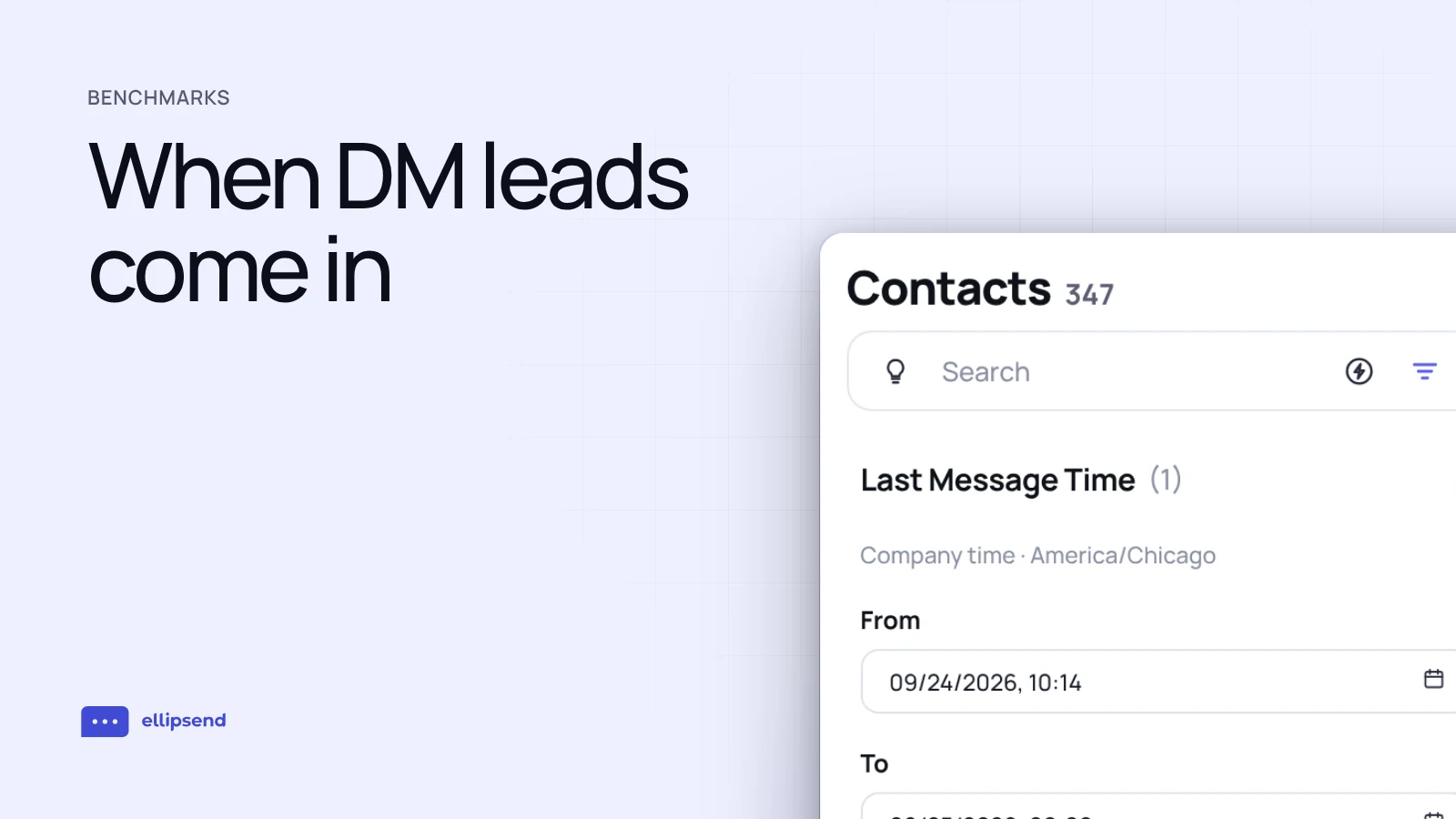
Across the Ellipsend accounts in our benchmarks, Instagram and Facebook DM leads peaked at Data coming and on Data coming, measured in each account's local time. A lead "arrives" when they reply to your automation and the conversation is ready for a human, usually a DM setter, the person who works your DMs to qualify leads and book calls. Data coming of leads landed during an hour when nobody on the team replied to any lead within 30 minutes. Your own pattern can differ, so build setter shifts from your own timestamps.
Most setter teams schedule around the setters. Nine to five, Monday to Friday, whatever time zone the team lives in. Leads don't keep those hours. If a big share of your leads show up after dinner, say 30% between 6pm and midnight, a nine-to-five team is answering almost a third of its pipeline the next morning.
That gap is easy to miss. Response rate can look fine because the setter does reply eventually. The lead just waited 14 hours for it.
What time of day do Instagram DM leads come in?
Here's when leads arrived across Data coming Ellipsend accounts with setters actively replying, over 30 days. Times are in each account's own local time. The last column shows how often those leads got a first human reply within 30 minutes.
| Time of day (account local time) | Share of new leads | Share handled within 30 minutes |
|---|---|---|
| 12am to 6am | Data coming | Data coming |
| 6am to 9am | Data coming | Data coming |
| 9am to 12pm | Data coming | Data coming |
| 12pm to 3pm | Data coming | Data coming |
| 3pm to 6pm | Data coming | Data coming |
| 6pm to 9pm | Data coming | Data coming |
| 9pm to 12am | Data coming | Data coming |
The busiest stretch was Data coming, which brought in Data coming of all leads. The quietest stretch was Data coming.
Read two things from the table. First, where the leads are. Second, where the leads are and the replies aren't. A block with a high share of leads and a low share handled within 30 minutes is where your pipeline leaks.
Why use the account's local time?
Because an 8pm lead for a Los Angeles team and an 8pm lead for a London team both hit the evening rush on their own team's clock, and sit eight hours apart in UTC. If you add accounts up in a single time zone, every account's evening rush lands in a different row and the peaks flatten into noise.
So every time in this article is converted to the time zone the account runs in before anything gets added up. If you sell to a global audience, your leads' local time can differ from yours. For scheduling setters that doesn't change much. What matters is when the lead lands in your inbox, measured on your team's clock.
What day of the week do the most DM leads come in?
| Day (account's local time) | Share of the week's leads | Share handled within 30 minutes |
|---|---|---|
| Monday | Data coming | Data coming |
| Tuesday | Data coming | Data coming |
| Wednesday | Data coming | Data coming |
| Thursday | Data coming | Data coming |
| Friday | Data coming | Data coming |
| Saturday | Data coming | Data coming |
| Sunday | Data coming | Data coming |
Weekends brought in Data coming of all leads. That's the number to hold up against how many setter hours you staff on Saturday and Sunday.
What is the after-hours gap?
The after-hours gap is the share of leads that arrive during an hour when nobody on the team replies to any lead within 30 minutes. Those are the hours nobody is covering in practice, whatever the schedule says.
Across our benchmarks, the after-hours gap was Data coming. Put plainly, that share of leads showed up at a time when the team wasn't there to catch them quickly.
It matters because the clock is already running. Speed to lead is the time between a lead replying to your automation and a setter sending their first message. The clock starts when the conversation is ready for a human. An automation starts the conversation and delivers what the lead asked for instantly. It can't qualify them or book the call. Every lead in the gap waits for a human, and the one I'd worry about is the lead who gets a faster reply from someone else while they wait.
How should you schedule setters around lead arrival?
Start from the curve, then fit people to it. Here are a few approaches by team setup.
| Team setup | What to do |
|---|---|
| One setter | Shift their hours to start later and end later, so the evening peak is covered and the slow morning isn't |
| Two or more setters | Stagger shifts, one early and one late, so the busiest hours have overlap |
| Setters in other time zones | Hire for the hours you can't cover, so your evening is their morning |
| Small weekend volume | One short weekend check-in shift instead of a full day |
| Gaps you can't staff | A morning sweep where the first hour goes to every lead that came in overnight, oldest first |
Here's an example of the math. Say you get 300 leads a week and 90 of them arrive between 6pm and midnight. That's 30% of your pipeline. If nobody is on after 6pm, a part-time evening shift from 6pm to midnight can cost less than a second full-time setter and covers almost a third of your leads.
The one I'd fix first is whichever block has the most leads and the lowest share handled within 30 minutes. That's where the most leads are waiting.
Coverage is also a fairness issue. If leads are split between setters by percentage and one setter works the dead hours, their speed to lead will look worse through no fault of their own. Compare setters on the hours they actually worked.
Does posting time change when DM leads arrive?
Partly. A lead can only arrive after someone sees your content and acts on it. So what you post, and when, shapes the curve.
But posting time and lead time aren't the same thing. A reel can keep collecting comments for days after it goes up. An ad keeps bringing people in for as long as it runs. Stories, lives and an always-on keyword automation each pull leads in on their own rhythm. A lead's arrival time mostly reflects when that person was scrolling and decided to act.
We're not going to give you a best time to post here. That depends on your audience, and your own lead data answers it better than a general rule. Compare lead arrival in weeks where you posted in the morning with weeks where you posted in the evening, and see whether the curve moved. Keep in mind one big post can bend a whole week, so look at several weeks before deciding.
How do you find your own lead arrival pattern?
You can do this yourself with a spreadsheet.
| Step | What to do |
|---|---|
| 1. Get the timestamps | Pull the date and time each new lead came in from wherever your conversations live. If your tool doesn't export them, have setters log the time each new lead lands for a few weeks |
| 2. Pick one arrival moment | Use the time the lead replied to your automation, so you're timing when a human is needed. The automation's own message time is too early |
| 3. Convert to your time zone | Make every timestamp your team's local time, and watch for daylight saving changes |
| 4. Pivot by time of day and weekday | Count leads per hour or per 3-hour block and per day of the week, then turn each count into a share of the total |
| 5. Add first reply time | Next to each lead, record when a setter first messaged them. Flag every lead that waited more than 30 minutes |
| 6. Find the gap | Look for hours where nobody replied to any lead within 30 minutes. The leads that arrived in those hours are your after-hours gap |
Use a real sample. Several weeks and at least 200 leads is a sensible floor, because a handful of leads in one time block can swing that row's share wildly.
Where does DIY lead tracking break?
It breaks in the same places manual tracking always does.
The arrival moment is hard to get. If your export only shows when a contact was created or when the first message went out, that's often the automation firing, not the lead replying. Getting the right moment means reading threads one by one.
Manual logs drift. A setter who has to note the time of every new lead in a busy evening will skip some. The skipped ones tend to come from the busiest stretches, which are the hours you most need to see.
Teams make it messier. With several setters, you need the first reply from anyone on the team, not each setter's own reply time. A spreadsheet that tracks setters one by one misses leads that sat unassigned.
And it goes stale. Your pattern moves when your content, ads or offer change. A pivot table built once and never rebuilt ends up describing last quarter.
How Ellipsend helps you cover the hours that matter
Ellipsend is a DM sales platform for setter teams. Every new lead from your Instagram and Facebook DMs lands in one shared inbox, and new leads can be split between setters automatically. Speed to lead and follow-ups come from the same conversations, so you can track them for your own team and hold them up against the hours your leads actually arrive.
Automations start the conversation instantly when someone comments or replies, at any hour, and your setters take it from there to sell. You can also see each setter's response rate and dollars per DM conversation (dollars per DM), so you can compare setters on results as well as speed.
Learn more about EllipsendFrequently asked questions
What time do most Instagram DM leads come in?
Across the Ellipsend accounts in our benchmarks, most Instagram and Facebook DM leads came in at Data coming, in each account's local time. A lead counts as arriving when they reply to the account's DM automation and the conversation is ready for a human setter. Every account's pattern differs, so check your own timestamps before setting shifts.
What is the best day of the week for Instagram DM leads?
In our benchmarks, Instagram and Facebook DM leads peaked on Data coming, and weekends brought in Data coming of the week's leads. The best day for your account depends on when you post, what you run ads on and who your audience is.
What is the after-hours gap in DM sales?
The after-hours gap in DM sales is the share of leads that arrive during an hour when nobody on the team replies to any lead within 30 minutes. Across our benchmark accounts it was Data coming. Those leads wait until a setter comes back online.
Should DM setters work evenings and weekends?
DM setters, the people who work your DMs to qualify leads and book calls, should work the hours your leads arrive in, which for some teams includes evenings or weekends. Check what share of your leads lands outside your current shifts. If it's large, weigh the cost of a short evening or weekend shift against the leads waiting on slow replies.
How do I find out when my DM leads arrive?
To find out when your DM leads arrive, collect the time each lead replied to your automation over several weeks, convert every timestamp to your team's local time, and count leads by hour of the day and day of the week. Add the time of the first setter reply to each lead to see which hours go uncovered.
 Know which posts make you money
Ellipsend gives setter teams one DM inbox, a sales pipeline and revenue traced to every post.
Try Ellipsend