Voice notes vs text in DMs: which gets more replies
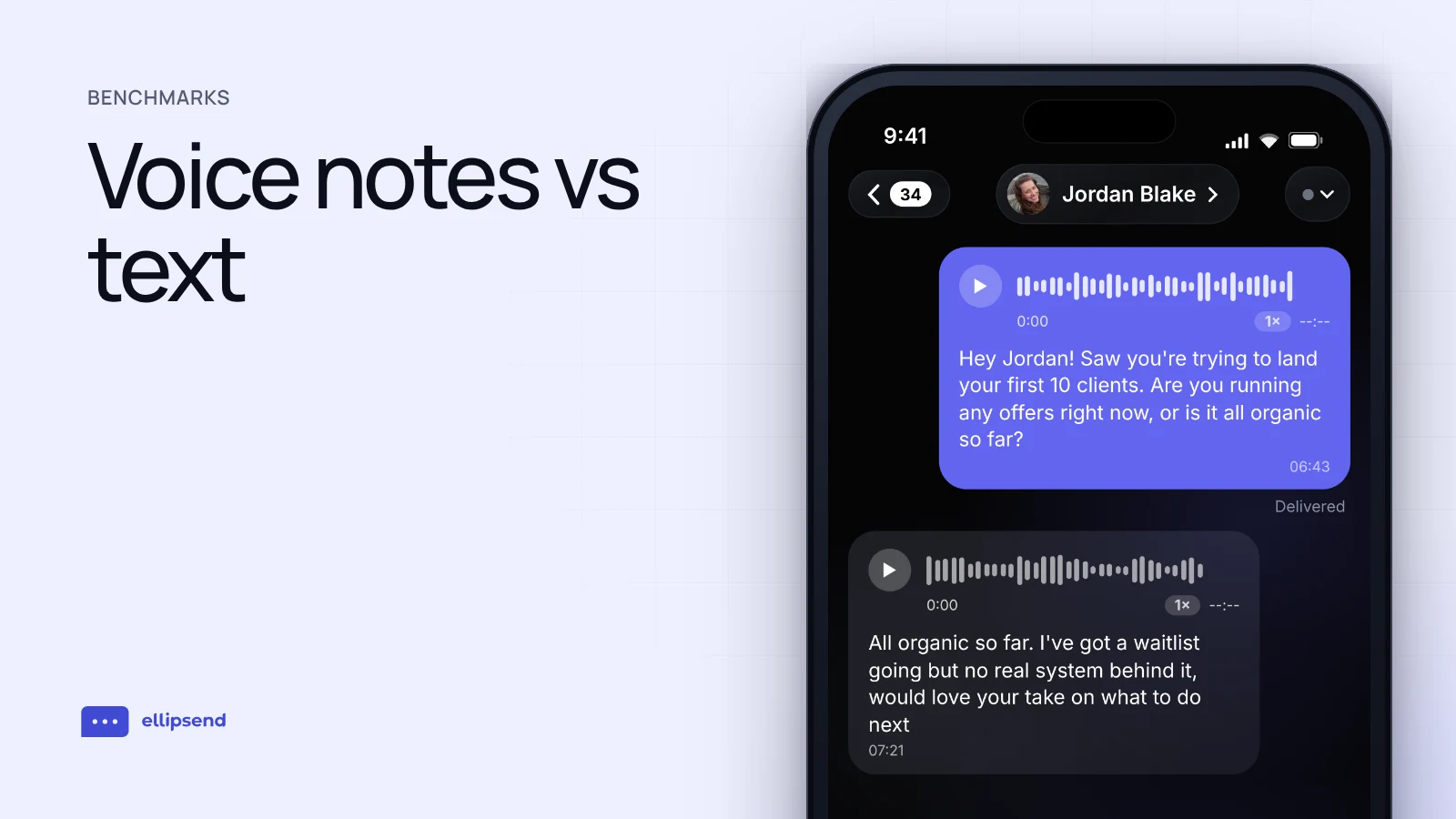
In our benchmarks, setter voice notes got a reply Data coming of the time, text messages Data coming and videos Data coming. A DM setter is the person who works your Instagram and Facebook DMs to qualify leads and book calls, and reply rate here means the share of a setter's messages that got an answer from the lead before the setter sent anything else. Voice notes tend to suit warming a lead up and the moments that need a personal touch. Text suits anything the lead needs to click, copy or reread.
Many setter teams pick a format by habit. One setter sends voice notes to everyone because someone told them voice notes convert. Another never sends one because recording feels awkward. Neither knows whether it's helping. Picture a 40-second voice note sent to a lead who just wanted the booking link. That's 40 seconds the lead has to sit through to find it.
Do voice notes get more replies than text in DMs?
Here's what we found across Data coming Ellipsend accounts with setters actively replying, over 30 days.
| Format | Share of setter messages | Reply rate |
|---|---|---|
| Voice note | Data coming | Data coming |
| Text | Data coming | Data coming |
| Video | Data coming | Data coming |
The numbers cover Data coming setter messages. No single account is identifiable in them, and the sample mixes niches.
Read the gap between formats as a signal that needs context. The section on cause and effect below explains why.
How did we measure reply rate by format?
We looked at every message a human setter sent in the DMs. Messages sent by automations were left out, because this article is about what a person should send.
Each setter message got sorted into one of three formats, voice note, text or video. Then we checked whether the lead replied before the setter sent their next message. If they did, that message counts as replied to. If the setter sent something else first, it doesn't.
That definition is a choice, and it has a side effect worth knowing. When a setter sends a voice note and then a text right behind it, and the lead answers after both, the reply counts toward the text. Setters who stack messages will see their first message undercounted. We picked this rule because it's simple to apply the same way across every account.
Why can't you read the numbers as pure cause and effect?
Because format and conversation stage travel together.
Setters rarely send voice notes at random. They tend to send them once a lead is already talking and already interested. Text shows up everywhere, including the cold first message after an automation and the fifth follow-up to someone who went quiet. So part of any lead voice notes have over text comes from who receives them, and the audio itself explains only some of it.
Say a setter sends a voice note only after a lead has said they want help, and sends text for every follow-up to people who stopped answering. The voice notes will look like they get far more replies. The leads receiving them were always more likely to reply.
The fair way to read the table is this. Voice notes perform well in the moments setters actually use them. Whether switching a cold follow-up from text to voice would lift replies is a separate question, and the only way to answer it for your team is to test it on the same kind of lead.
When do voice notes make sense in DM sales?
Voice notes show there's a real person on the other end in a way text rarely does. That's worth the most in three places.
Warming a lead up. Someone commented a keyword, got their free resource from your automation, and replied. A short voice note that uses their name and reacts to what they said tells them this isn't another bot. It's a strong way to open the human part of the conversation.
After qualification. Once you know what the lead wants and it fits your offer, a voice note explaining the next step in plain words carries more warmth than a paragraph. It's where tone does some of the selling.
When a lead has gone quiet. A personal voice note to someone who stopped replying can stand out in an inbox full of text. Our own help docs suggest exactly this for leads who got the free resource and never answered.
When is text better than a voice note?
Text wins any time the lead has to do something with the message.
Links go in text, sent as a button. Nobody can tap a link they heard in a voice note. Buttons also matter for tracking, since a button link can carry a tag that ties the click back to the lead.
Details go in text. Prices, dates, call times, what to bring to the call, the name of the program. Anything the lead might need to find again later should be something they can scroll back to and reread. A voice note forces them to replay it.
Quick answers go in text. If the lead asked a yes-or-no question, a voice note makes them do more work for less. "Yes, Tuesday at 3pm works. Here's the link to grab a time." beats 30 seconds of audio saying the same thing.
Some leads can't listen. They're at work, on a train, or in a room with other people. Text reaches them right away. A voice note waits until they can play it.
What about video messages?
Video is the most personal format and the heaviest one to receive. It suits the same moments voice notes do, with one more reason to use it, which is showing the lead something.
Keep it short. Our own recommendation is to keep videos sent in the DMs under 10 seconds. For anything longer, host the video somewhere and send a link to it as a button. The lead gets the full video and you keep the tracking.
How long should a DM voice note be?
Short enough to listen to in one go without checking how much is left. Under a minute is a good ceiling, and most of the ones that do their job are well under that.
One point per voice note. Say their name, react to what they said, and end with one clear question. If you need to explain three things, that's a sign the details belong in text.
And never send a generic voice note. A recorded message that could go to anyone loses the one thing that made it worth sending.
Should setters mix voice notes and text?
Yes. The strongest pattern is usually a voice note for the human part and a text for the action. A voice note that says "I'm sending you the link to book, grab whatever time works" followed by the booking link as a button gives the lead the warmth and the thing to click.
Two habits make mixing work. Keep the action in the last message, since that's the one the lead acts on. And don't stack three or four messages in a row. If the lead opens the thread to a wall of audio and text, the easy move is to answer later. Later often turns into never.
How can you track reply rate by format yourself?
You can do a rough version with a spreadsheet.
Pick one setter and their last 50 conversations. For every message they sent, log the format and whether the lead replied before the setter's next message. Add a column for the stage of the conversation, like first message, mid-conversation or follow-up. Then compare reply rates by format inside each stage. That last step is what keeps the stage problem from fooling you.
It works for a one-time check. It breaks in a few places once you try to keep it going.
It doesn't scale past one or two setters. Logging every message by hand takes hours, and setters doing it themselves are setters not in the DMs.
Stage is a judgment call. Two people will label the same conversation differently, so your numbers drift with whoever filled in the sheet.
It stops at the reply, and a reply is only the start of a sale. A spreadsheet like this can't tell you which format led to a booked call or money in the bank, so you can end up optimizing for chatty leads instead of buyers.
How Ellipsend helps setters use voice notes and text
Ellipsend is a DM sales platform for setter teams. Setters can record voice notes, send video and send links as buttons from one shared inbox. Save voice notes and reuse them in any conversation, along with the links and text scripts your team uses often. Saved voice notes work best as reusable intros and explanations, like how your calls work, with the lead's name and a personal line from the setter around them, so none of it reads as generic. A link sent as a button carries a tracking tag, so a click can be tied back to the lead.
That lets you judge setters on what their conversations produce, and message volume matters less. You can compare dollars per DM conversation (dollars per DM) by setter, so when someone changes how they use voice notes, you can see whether revenue moved.
Learn more about EllipsendFrequently asked questions
Do voice notes get more replies than text on Instagram?
Voice notes sent by DM setters got a reply Data coming of the time in our benchmarks, against Data coming for text. Setters tend to send voice notes to leads who are already engaged, so part of that difference comes from who receives them as well as from the format.
When should a DM setter send a voice note instead of text?
A DM setter should send a voice note when the goal is to show there's a real person in the conversation. That's usually when warming up a new lead, after the lead has qualified for the offer, or when following up with someone who went quiet. Links, prices, dates and anything the lead needs to reread belong in text.
How long should a voice note in a sales DM be?
A voice note in a sales DM should be short enough to hear in one go, and under a minute is a good ceiling. Make one point, use the lead's name, and end with one clear question. If there are several details to share, put them in a text.
Should you send links in a voice note?
No, you shouldn't send links in a voice note, because a link mentioned out loud can't be tapped. Send the voice note, then send the link in its own message as a button, so the lead can click it and the click can be tracked back to them.
Are video messages good for DM sales?
Video messages in DMs work for the same moments as voice notes, especially when you need to show the lead something. Keep DM videos under 10 seconds. For longer videos, host them elsewhere and send a link to the video as a button.
How do you measure reply rate for DM messages?
Reply rate for DM messages is the share of messages a setter sent that got an answer from the lead before the setter sent anything else. To compare voice notes, text and video fairly, compare them inside the same stage of the conversation, since setters tend to save voice notes for leads who are already engaged.
 Know which posts make you money
Ellipsend gives setter teams one DM inbox, a sales pipeline and revenue traced to every post.
Try Ellipsend