How many DM follow-ups does it take to get a reply?
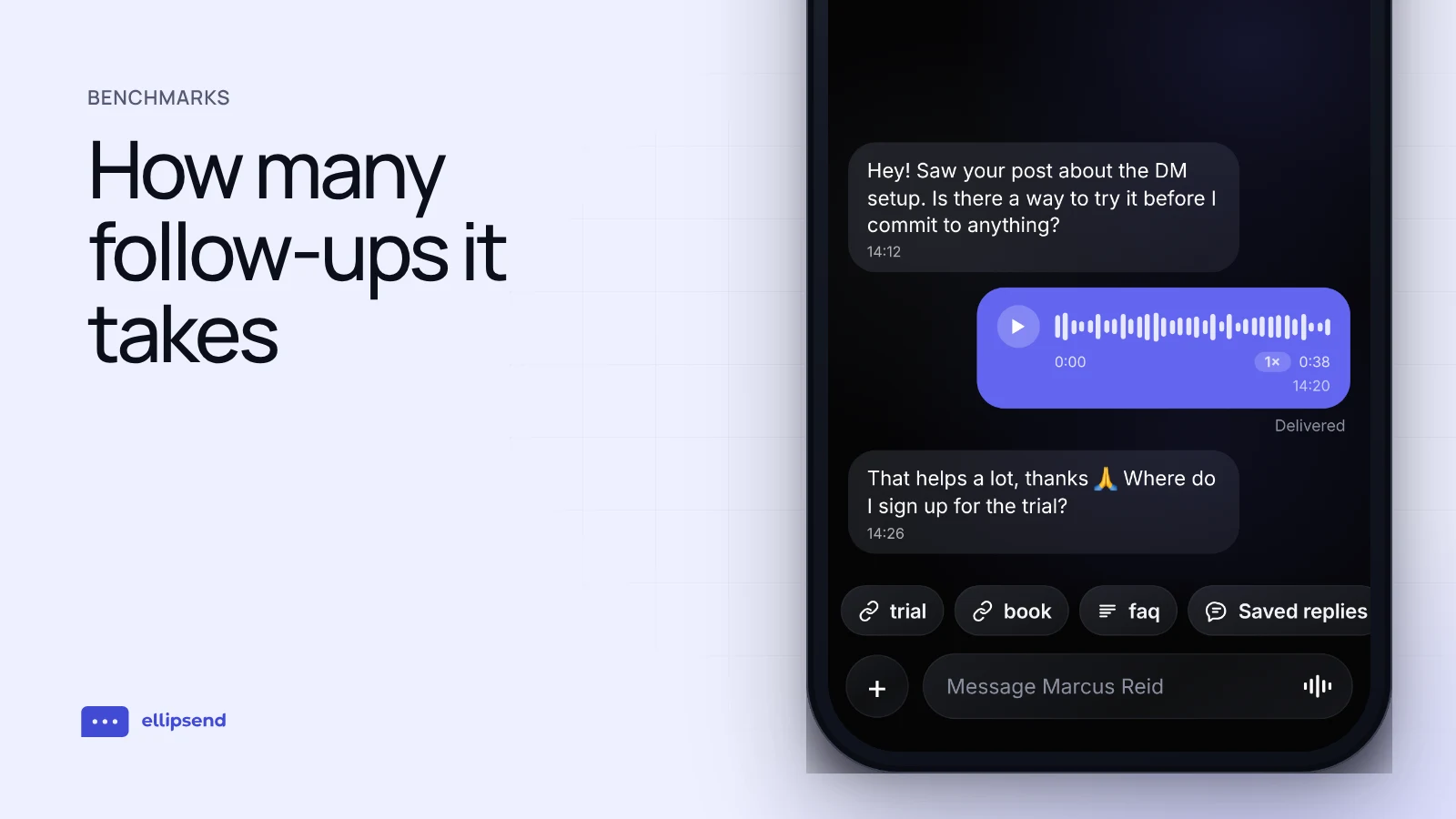
Across the Ellipsend accounts in our benchmarks, Data coming of first follow-ups got a reply, Data coming of second follow-ups and Data coming of third follow-ups. A follow-up is a message a DM setter, the person who works your Instagram and Facebook DMs to qualify leads and book calls, sends after a lead stops replying. We recommend up to three follow-ups, spaced out inside Instagram's 7-day messaging window, then letting the lead go. A follow-up that never gets sent can't get a reply, so coverage matters as much as the message.
A lead who goes quiet hasn't said no. They got busy, saw the message on the train and forgot, or wanted to think about it.
Most setter teams treat that silence as a verdict anyway. The lead drops to the bottom of the inbox, nobody sends a second message, and seven days later Instagram won't let you reply at all.
What counts as a lead going quiet?
For this article, a lead has gone quiet when the setter sent the last message and 24 hours passed with no reply. A follow-up is any message the setter sends after that point, before the lead writes back.
We picked 24 hours on purpose. A second message an hour later in a live conversation is just a conversation. A message sent after a full day of silence is a deliberate attempt to bring someone back, and that's the habit worth measuring.
Leave out conversations that ended on their own. A lead who booked a call, bought, or was marked as not a fit doesn't need chasing, and counting them makes your numbers look worse than they are.
How do you measure follow-ups?
Two numbers, and they answer different questions.
| Metric | What it tells you | How to calculate it | Benchmark |
|---|---|---|---|
| Follow-up coverage | Whether quiet leads get chased at all | Quiet leads that got at least one follow-up ÷ leads who went quiet | Data coming |
| Follow-up reply rate | Whether those follow-ups bring people back | Follow-ups that got a reply ÷ follow-ups sent | Data coming |
Coverage is a discipline number. It's fully in the setter's hands, and it's the one I'd watch first. A follow-up that never gets sent has a reply rate of zero.
Reply rate is a quality number. If a setter follows up with everyone and almost nobody answers, the messages need work.
Count a follow-up as replied to when the lead writes back before the setter's next message.
What's the reply rate on the 1st, 2nd and 3rd follow-up?
Here's what the benchmark accounts showed, split by follow-up number.
| Follow-up | Reply rate |
|---|---|
| 1st | Data coming |
| 2nd | Data coming |
| 3rd | Data coming |
| 4th and later | Data coming |
Taken together, Data coming of quiet leads that got at least one follow-up came back into the conversation.
Expect each follow-up's reply rate to be lower than the one before it. That doesn't make later follow-ups pointless. The second follow-up only goes to people who ignored the first, so it's working a harder group.
Here's an example with made-up numbers to show how it adds up. Say 100 leads go quiet in a week.
| Step | Leads messaged | Replied | Reply rate |
|---|---|---|---|
| 1st follow-up | 80 | 20 | 25% |
| 2nd follow-up | 60 | 9 | 15% |
| 3rd follow-up | 51 | 5 | About 10% |
| Total | 80 of 100 covered | 34 |
The third follow-up looks weak on its own at about 10%. It still brought back 5 leads who were otherwise gone.
The 20 leads who never got a follow-up are the real leak in this example. Raising coverage from 80% to 100% would put 20 more people in front of a first follow-up, and that's usually an easier win than rewriting the messages.
How long should you wait between DM follow-ups?
Instagram's messaging window sets the outer limit, so start there.
Meta's messaging policy gives businesses 24 hours to respond to a person's message, and messages inside that window can be promotional. After 24 hours, Meta's Human Agent tag lets a person on the business's side reply manually for up to 7 days. Meta also says tagged messages sent outside the 24-hour window must be non-promotional, and Human Agent is one of those tags.
With the 24-hour quiet rule above, every follow-up lands in that second window. That has two consequences. Meta's Human Agent tag is for a person replying manually, and Meta says tagged messages sent outside the window must be non-promotional, so write each follow-up by hand and keep it out of pitch territory. And you have until day 7 after the lead's last message. After that the tag no longer covers a reply, and the next chance comes when they message you again.
A spacing that fits inside the window looks like this.
| Follow-up | When to send it, counted from the lead's last message |
|---|---|
| 1st | Day 1 to 2 |
| 2nd | Day 3 to 4 |
| 3rd | Day 5 to 6, before the window closes |
Spread the sending out too. Across the accounts we work with, a setter working through a long list of quiet leads in one sitting is a pattern that gets accounts flagged. Send 5 to 10 at a time and spread them through the day. That's what we've seen, not a published Meta rule.
Can you follow up with someone who commented but never replied?
Not beyond the first private reply. When someone comments on your post and your automation sends them a private reply, Meta allows one message per commenter. You can only message them again after they reply.
That's why your opening automation message should give people a reason to tap or answer. Until they do, there's no conversation to follow up on. Leads who took the free resource and replied, then went silent on your setter, are the ones this article is about.
What should a DM follow-up say?
Something worth replying to. "Just checking in" and "did you get a chance to look at this?" give the lead nothing new, so most people don't answer them.
A good follow-up does one of these things. It picks up something the lead already told you. It sends something useful tied to their situation. Or it asks one easy question they can answer in a few words.
Here are two examples for a fitness coach whose lead said bad knees were stopping them from running.
"Hey Sam, you mentioned your knees were the thing holding you back. Here's the 4-minute warm-up we give every new client before their first run."
"Quick one, Sam. Is it more the pain during the run or the stiffness the day after?"
Both are personal, neither is a pitch, and both are easy to answer. A short voice note that does the same thing works well too.
Write each one fresh. Across the accounts we work with, the same canned follow-up pasted to 40 quiet leads after 24 hours is the kind of pattern we see get accounts flagged.
When should a setter stop following up?
After three follow-ups with no reply, let them go. That's the line in our own DM restrictions guidance, and it's where we'd draw it for most teams.
Stop earlier when the window closes. Past day 7 the setter can't send anything anyway.
When you stop, mark the lead so nobody keeps chasing. A lead who comes back on their own a month later opens a fresh window, and the conversation starts again from there.
Keep the tone steady to the end. A third follow-up that turns guilt-trippy does more damage than not sending it.
How do you track follow-ups without a CRM?
A spreadsheet works for a small team. One row per quiet lead, with the setter's name, the date of the lead's last message, the dates of follow-ups 1, 2 and 3, and whether the lead replied after each one. Coverage and reply rate by follow-up number fall straight out of those columns.
It breaks in three places.
The setter has to log every send. In the middle of 40 open conversations, the spreadsheet is the first thing to slip, and every minute spent on it is a minute not spent in the DMs.
The window keeps moving. Someone has to work out, every day, which quiet leads are on day 2 and which are on day 6, before the chance is gone.
The data is self-reported. A setter with low coverage is also the setter least likely to log the follow-ups they skipped, so the sheet looks best exactly where it's least true.
How to track follow-ups in Ellipsend
Ellipsend is a DM sales platform for setter teams. Every setter works from one shared inbox, where you can pull up the leads waiting on a reply and see which are still inside Meta's 7-day window, so they get followed up before it closes.
Speed to lead and follow-ups come from the same conversations, so nobody fills in a sheet. You can see how many follow-ups each setter sends and how many get a reply, and set that next to their dollars per DM conversation (dollars per DM). Once tracking is set up, leads can also be tied back to the post, story or ad that brought them in.
Learn more about EllipsendFrequently asked questions
How many times should you follow up on an Instagram DM?
Follow up on an Instagram DM up to three times after a lead goes quiet, then let them go. Each follow-up should be personal and give the lead a reason to reply. Three follow-ups also fit comfortably inside Instagram's 7-day window for manual replies.
How long should you wait between DM follow-ups?
Space DM follow-ups a day or two apart, counted from the lead's last message, so the first lands on day 1 to 2, the second on day 3 to 4 and the third on day 5 to 6. Meta's Human Agent tag covers manual replies for up to 7 days, so a follow-up plan should finish inside that period.
Can you send a DM follow-up after 24 hours on Instagram?
Yes. Meta gives businesses 24 hours to reply to a person's message, and after that its Human Agent tag lets a person reply manually for up to 7 days. Meta says tagged messages sent outside the 24-hour window must be non-promotional, so a follow-up after 24 hours should be personal and should stay out of pitch territory.
What is follow-up coverage in DM sales?
Follow-up coverage is the share of quiet leads that got at least one follow-up from a DM setter. A lead has gone quiet when the setter sent the last message and the lead hasn't replied in 24 hours. Calculate it as quiet leads that got a follow-up divided by all leads who went quiet.
What is a good DM follow-up message?
A good DM follow-up message gives the lead something new to respond to. It picks up something they said, sends something useful for their situation, or asks one easy question. "Just checking in" adds nothing, and the same canned message sent to everyone after 24 hours is a pattern we've seen get Instagram accounts flagged.
Why can't I DM someone who commented on my post?
Meta allows one private reply per commenter on Instagram. After that first message from your automation, you can only message the person again once they reply. Until they do, there's no open conversation to follow up on.
 Know which posts make you money
Ellipsend gives setter teams one DM inbox, a sales pipeline and revenue traced to every post.
Try Ellipsend